
 Sky Duty
Which inspections apply to your aircraft
The inspection rules for US civil aircraft are in 14 CFR part 91 subpart E (91.409). Which route applies turns on the aircraft and how it is flown: for hire or not, and its size and engines.
An aircraft maintenance program, in FAA terms, is the inspection schedule an aircraft follows instead of the annual and 100-hour: an inspection program under 14 CFR 91.409(f) for large airplanes and multiengine turbine airplanes, an approved aircraft inspection program under Part 135, or a maintenance program for charter aircraft with ten or more passenger seats.
| Route | Applies to | How often | Performed or scheduled by |
|---|---|---|---|
| Annual, 91.409(a) | Aircraft on no other route | Within the preceding 12 calendar months | A person authorized under 43.7, such as a mechanic with an inspection authorization (IA) |
| 100-hour, 91.409(b) | Aircraft carrying anyone but crew for hire, or provided for flight instruction for hire | Within the preceding 100 hours of time in service | An A&P mechanic |
| Progressive, 91.409(d) | Aircraft whose owner or operator asks Flight Standards in writing | A full inspection within each 12 calendar months, in stages | A mechanic with an IA, a certificated airframe repair station or the manufacturer |
| Inspection program, 91.409(e), (f) | Large airplanes and multiengine turbojet or turboprop airplanes | As the selected program schedules it | The person the program names schedules them |
| AAIP, 135.419 | Part 135 aircraft listed in the operations specifications | Time in service, calendar time, system operations, or a combination | As the program's instructions and procedures set out |
The annual and 100-hour rules do not apply to an aircraft on a special flight permit or with an experimental, light-sport or provisional certificate, to an aircraft on an approved inspection program under part 125 or 135 named in that operator's operations specifications, or to an aircraft under a progressive inspection or a selected inspection program (91.409(c)).
The annual inspection (14 CFR 91.409(a))
No one may operate an aircraft unless, within the preceding 12 calendar months, it has had an annual inspection under part 43 and been approved for return to service by a person authorized under 14 CFR 43.7.
The holder of an inspection authorization (IA) may perform an annual inspection (65.95).
A 100-hour inspection cannot stand in for the annual unless a person authorized to perform annuals does it and enters it as an annual in the maintenance records.
The annual and the 100-hour cover the same scope, part 43 appendix D (65.95, appendix D). What differs is who may perform them, and which aircraft need the 100-hour as well.
Scheduling, logbook, maintenance and expenses, in one app.

$39 per aircraft per monthUnlimited users
No card needed.
Free for 14 days with up to 2 aircraft.
Add the rest when you subscribe.
Talk to the teamA person answers.
Sky Duty runs on iPhone and iPad. Scan to get it.
See what is due on each aircraft before it flies
Download Sky Duty and each aircraft's inspections count down by date, hours or cycles, and the trip form shows what is due on the aircraft you pick.
$39 per aircraft per monthUnlimited users
No card needed.
Free for 14 days with up to 2 aircraft.
Add the rest when you subscribe.
Talk to the teamA person answers.
Sky Duty runs on iPhone and iPad. Scan to get it.
The 100-hour inspection (14 CFR 91.409(b))
An aircraft that carries any person other than a crewmember for hire, or that its owner provides for flight instruction for hire, must have had an annual or a 100-hour inspection within the preceding 100 hours of time in service.
The rule does not reach an aircraft flown privately that carries no one for hire; that aircraft still needs its annual.
The 100 hours may be exceeded by up to 10 hours while the aircraft flies to a place where the inspection can be done, and that extra time counts toward the next 100 hours.
For maintenance records, time in service runs from the moment the aircraft leaves the surface of the earth until it touches it at the next point of landing (14 CFR 1.1). That is airborne time, so a Hobbs meter that runs from engine start reads more than time in service.
A certificated mechanic may perform the 100-hour inspection and approve the aircraft for return to service: the airframe with an airframe rating, and the powerplant and propeller with a powerplant rating (65.85, 65.87).
Inspection programs: the aircraft maintenance program
Large airplanes and multiengine turbojet and turboprop airplanes do not use the annual and 100-hour.
Under 91.409(e) they replace life-limited parts within their replacement times and are inspected under a program selected under 91.409(f).
Turbine-powered rotorcraft follow the same rule or may choose the annual, 100-hour or progressive route.
A single-engine turboprop is not in paragraph (e): it uses the annual, plus the 100-hour when it is flown for hire.
The owner or operator chooses one of four programs under 91.409(f):
- the continuous inspection program of a part 121 or 135 operator flying that make and model;
- an approved aircraft inspection program under 14 CFR 135.419, in use by a part 135 operator;
- the manufacturer's recommended inspection program;
- a program the owner or operator writes and the FAA approves.
The program chosen is identified in the aircraft's maintenance records, names the person responsible for scheduling its inspections, and is made available to whoever performs them.
That is why a twin-turboprop or jet flight department talks about its inspection program rather than an annual.
A progressive inspection, by contrast, spreads the inspection over the year: the registered owner or operator asks the responsible Flight Standards office in writing, provides an inspector, a procedures manual, the facilities and the technical information, and completes a full inspection within each 12 calendar months.
Part 135 aircraft: the AAIP and the maintenance program
A Part 135 aircraft with nine or fewer passenger seats, not counting pilot seats, is maintained under parts 91 and 43 plus 135.415, 135.417, 135.421 and 135.422, and may use an approved aircraft inspection program (AAIP) under 135.419.
An aircraft with ten or more passenger seats is maintained under a maintenance program (135.411(a)).
An AAIP is added to the operator's operations specifications; it sets out the inspection instructions and procedures, a schedule in time in service, calendar time, system operations or a combination, and how discrepancies are recorded and corrected or deferred, and it lists each aircraft on it by registration number (135.419).
For who may do preventive maintenance on a Part 135 aircraft, see preventive maintenance below. For the certificate itself, see what a Part 135 certificate is; for the software side, the Part 135 charter software page.
Altimeter, transponder and ELT checks
To fly an airplane or helicopter under IFR in controlled airspace, each static pressure system, each altimeter and the altitude reporting system must have been tested and inspected within the preceding 24 calendar months under part 43 appendices E and F (91.411).
Flying under VFR alone does not trigger it. A required ATC transponder must have been tested and inspected within the preceding 24 calendar months under part 43 appendix F (91.413).
A required emergency locator transmitter (ELT) must be inspected within 12 calendar months after its last inspection, for proper installation, battery corrosion, operation of the controls and crash sensor, and a sufficient signal from its antenna (91.207(d)).
Its batteries are replaced, or recharged if rechargeable, when the transmitter has been in use for more than 1 cumulative hour or when 50 percent of their useful life has expired, and the new expiration date goes on the transmitter and in the maintenance record (91.207(c)).
ADs and the manufacturer's limitations
An AD (airworthiness directive) is an FAA rule under 14 CFR part 39 that applies to aircraft, engines, propellers and appliances.
Each one specifies the inspections to carry out, the conditions and limitations to meet, and the actions to take to resolve an unsafe condition.
The owner or operator is primarily responsible for maintaining the aircraft, including meeting the ADs that apply to it (91.403(a)).
Operating an aircraft or product that does not meet an applicable AD is a violation, and each operation is a separate violation (39.7, 39.9).
When the manufacturer's maintenance manual or instructions include a limitations section, its mandatory replacement times, inspection intervals and procedures, or approved alternatives, must be followed before the aircraft is operated (91.403(c)).
What the maintenance records must show
Records of maintenance, preventive maintenance, alterations and the required inspections include a description of the work, the date it was completed, and the signature and certificate number of the person approving the aircraft for return to service (91.417(a)(1)).
The owner or operator also keeps the total time in service of the airframe, each engine, propeller and rotor; the status of life-limited parts; the time since overhaul of items overhauled on a time basis; the aircraft's inspection status; the status of applicable ADs, with how each was met and, if it recurs, when the next action is due; and copies of Form 337 for major alterations (91.417(a)(2)).
Work records are kept until the work is repeated or superseded, or for 1 year after it is done; the time, status and AD records go with the aircraft when it is sold (91.417(b)).
A maintenance entry also names who did the work and the approver's kind of certificate (43.9(a)).
An inspection entry records the type and extent of the inspection, the aircraft's total time in service and the FAA's certifying statement (43.11(a)).
What an annual or 100-hour inspection checklist covers
Whoever performs an annual or 100-hour inspection must use a checklist: their own, the manufacturer's or one from another source, covering at least the scope and detail of part 43 appendix D (43.15(c)(1)). The inspector opens the inspection plates, access doors, fairings and cowlings and cleans the aircraft and engine, then inspects, where applicable:
- the fuselage and hull group;
- the cabin and cockpit group;
- the engine and nacelle group;
- the landing gear group;
- the wing and center section;
- the empennage;
- the propeller group;
- the radio group;
- and any other installed item.
Before approving a piston-engine aircraft for return to service after an annual or 100-hour inspection, the approver runs the engines to check power output (static and idle rpm), magnetos, fuel and oil pressure, and cylinder and oil temperature against the manufacturer's recommendations; turbine engines get a run to the manufacturer's recommendations (43.15(c)).
This list names appendix D's groups so you know what an inspection covers; it is not a checklist to inspect from.
Preventive maintenance an owner-pilot may do
A pilot certificate holder, other than a sport pilot, may perform preventive maintenance on an aircraft the pilot owns or operates, as long as it is not used under part 121, 129 or 135 (43.3(g)).
Preventive maintenance is limited to the work listed in part 43 appendix A(c), done without complex assembly, for example removing, installing and repairing landing gear tires; replacing or cleaning spark plugs and setting the gap; replacing and servicing batteries; and replacing bulbs, reflectors and lenses of position and landing lights (appendix A).
A task the list does not name is a question for your A&P or the FAA, not for this page.
The rules on this page were read on the eCFR, title 14, up to date as of October 29, 2026. Regulations change: read the rule itself before relying on any interval, and ask your A&P or IA about your aircraft.
Keeping what's due in view with Sky Duty
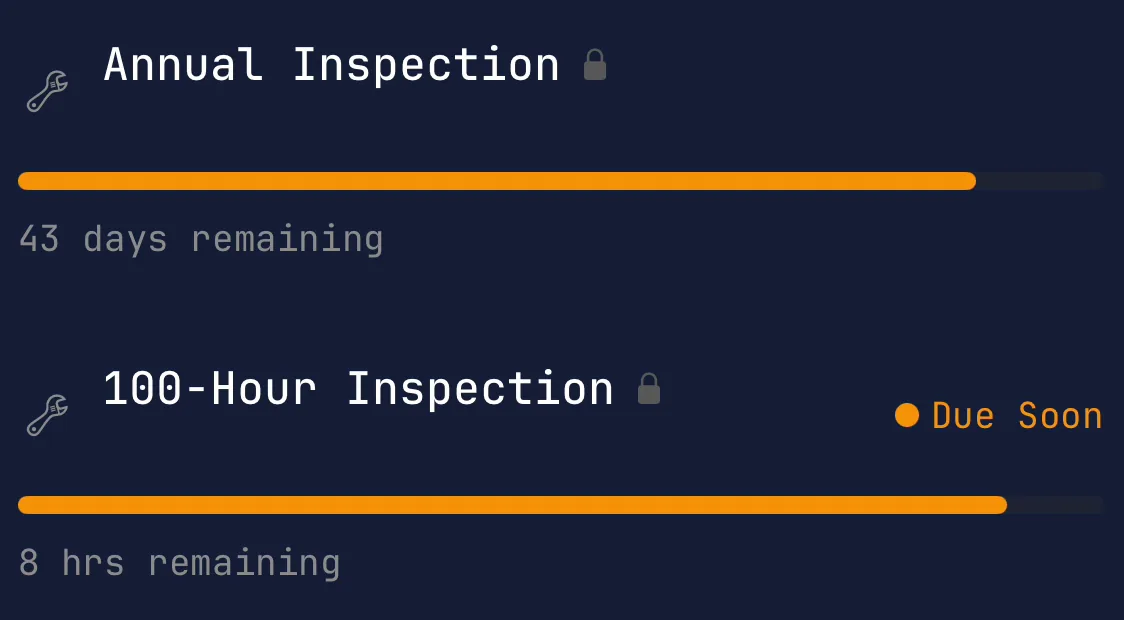
Add an aircraft to Sky Duty and its maintenance list starts from built-in templates, each showing the regulation it comes from: the Annual Inspection (91.409(a)), the Transponder/Mode C Certification (91.413), the Pitot-Static/Altimeter IFR Certification (91.411) and the ELT Inspection (91.207), plus a 100-Hour Inspection (91.409(b)) on piston aircraft.
Each item counts down by date, hours or cycles. On an aircraft kept to an inspection program, the program and the aircraft's records set what is due, and a template item that does not apply can be removed.
The demo fleet's maintenance list
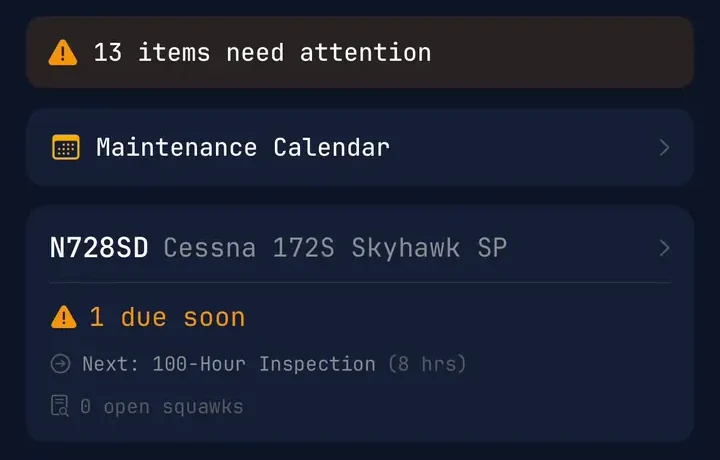


When the work is done, log it with who did it, their A&P and IA numbers, the date and a sign-off status; logged against a tracked item, it restarts that item's countdown, and maintenance logs export to PDF or CSV. Pick an aircraft for a trip and the trip form lists what is overdue or due soon, open squawks and overlapping downtime; a grounded aircraft is flagged there, and the trip saves after you choose to override.
Records and squawks save on the device with no signal and sync when you reconnect.
Two honest notes.
The countdowns are a planning view, not the rule: the annual template counts 365 days from the logged date where the rule counts 12 calendar months, and the 100-hour template counts Hobbs hours where the rule counts time in service.
And a Sky Duty record is not the signed entry in the aircraft's maintenance records: its sign-off status is a field someone sets, and Sky Duty won't sign off maintenance.
The records, and your A&P or IA, settle what is due. See the countdowns, squawks and grounding on the aircraft maintenance tracking page.